Showing posts with label patience. Show all posts

Thursday, 18 August 2016

Don't put Happiness on Hold

I'm rereading my new favorite book series (at least until I reread Harry Potter, probably) and it's just as much fun as the first time through. I rushed my first reading, I think because I wanted to see what was going to happen with the (very understated but awesome) love story. I admit that mattered more to me than the other huge happenings that affected more characters and defined the main plotline. Not that that says a lot about me or anything.

My second readthrough is also amazing, but it's different. I'm struck by plenty of foreshadowing and details I missed the first time through. Things I didn't think mattered at all became super important in light of the eventual conclusion. There were clues sprinkled all throughout the books that I didn't have the proper perspective or patience to pick up on before. I was too distracted by pressing ahead to see how things would turn out.

Knowing the ending doesn't make me appreciate the story less; it gives me hope for the hard times. When something terrible happens, I can tell myself, "it's all gonna be okay." I can enjoy the time I have with the characters, knowing some of them die. I can appreciate the richness of a friendship before betrayal enters the picture. I know good wins, even when all seems to be lost.

I liken my first readthrough to my natural (fleshly, in Christianese) inclination to live quickly and impatiently rush through boredom to juicier things; in other words, how I've lived most of my life. In this mindset, waiting to get what I want seems a mistake: something to be endured, not enjoyed. My second readthrough more resembles living with a redeemed mind and eternity in view. This unhurried state is relatively new to me and feels a million times better.

Though many of my hopes for my life have yet to materialize, I've realized I don't have to wait to be thankful, and I don't have to get upset when the road seems to turn the opposite direction. It's as simple as imagining how I hope to feel when my dreams come true and allowing myself to feel that right now, no strings attached. Why should I put my excitement on hold? It could be years... time wasted or dissipated into other emotions besides gratitude, excitement and joy. I see no reason to wait. If my dreams do not come to pass, then I've at least lived several extra years with positive emotion. And this isn't just wishful thinking or fantasy; as a child of God, called according to His purposes, I know for sure something good is coming for me.

I think this is what Paul meant when he wrote that "we boast in the hope of the glory of God. Not only so, but we also glory in our sufferings, because we know that suffering produces perseverance; perseverance, character; and character, hope. And hope does not put us to shame," (Romans 5:2b-5a) I think boredom or waiting can be considered a form of suffering, but we can still be totally okay with them, knowing what's coming. And I think the last verse means we won't regret hope or be embarrassed we hoped, both because God's promises are true and Jesus is actually coming back and because hoping is an honorable and positive thing, whether or not life turns out the way we expected it to.

As a sidebar, I also find that trusting my path is headed for good releases me from feeling envious of my friends (most of the time!). I can honestly celebrate with those who celebrate, seeing each success story as proof that success keeps coming for us all one by one, rather than thinking there's a success pie that's shrinking as it's served up and if I don't get my slice soon I'll starve.

In my head I've been calling this mindset "preemptive gratitude," though "faith" and "trust" would both work well. The Bible calls it hope a few times. Romans 8:24b-25 says that "hope that is seen is no hope at all. Who hopes for what they already have? But if we hope for what we do not yet have, we wait for it patiently." Hope is good (duh), but it's not possible to hope for what we have. Earthly life is our one chance to love God by trusting Him and believing in His promises even though we can't yet see the outcome. When our earthly lives are through, our faith (our hope) will be turned to sight. Living in a world that's still broken provides our only chance at hope. And by the way, what is more majestic: a light shining in broad daylight or a light that shines in darkness?

Christ-followers know good wins in the end. This is why celebration and dancing and feasting are all appropriate even in this world full of crime and hate and poverty, why we say of God, "You prepare a table before me in the presence of my enemies." (Psalm 23:5a) This verse closely relates to enjoying and savoring my book because I know for sure that the very real and dangerous threats from the enemy won't derail the ultimate mission. Joy isn't insensitive or thoughtless; it's acknowledging a deeper truth. We're all free to ease up on the breakneck pace and enter fully into our lives, secure in a good ending. We can delight in each twist and turn of the story without rushing or despairing. We can celebrate the happy ending right now and let it inform all our choices until it gets here. We don't have to wait to be glad it all turns out well: we can celebrate that truth today, in whatever city and life station we presently find ourselves.

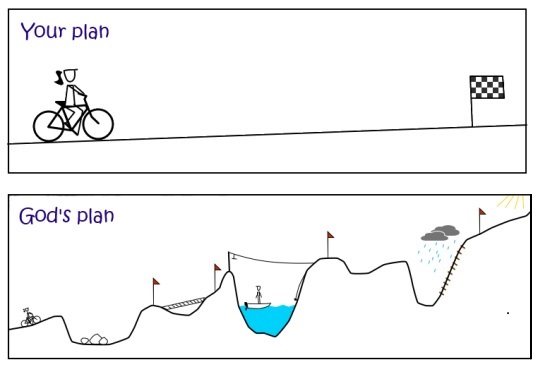
"Let us hold unswervingly to the hope we profess, for he who promised is faithful." (Hebrews 10:23) Let's enjoy the benefits of hope now, despite obstacles, because we can, and because the author of the story of humanity and the world is trustworthy and has promised us a good ending.

Saturday, 11 June 2016

Writing with your Path

"I'm a little pencil in the hand of a writing God, who is sending a love letter to the world." - Mother Teresa

I'm not sure how to attribute this cartoon; I've seen it a few places:


The bottom one looks like a recording of a heartbeat. In comparison, the top one looks like the flatline that means death. The top image is boring. The bottom reminds me of the ups and downs of handwriting. Something with personality. A path much more interesting to write, read, and live.

Applied to a sheet of paper to write a story, a pencil might wonder, "why all the back and forth?" not realizing that that is how letters are formed. It would probably feel very jerky and awkward: "Do you even know what you're doing, writer? Why am I being bumped around so much? Can we make this any smoother?" Even in the smoothest cursive, a writer must cross t's and dot i's. Maybe letters are the repeated rituals of our days. Sipping water. Checking a phone. Driving to work. Walking from room to room. Cooking. Eating. Laundry. More cooking. It takes a lot of repeated occurrences of these to make a life, to make a story. It wouldn't be a very long or interesting story if no letter could be reused.

Maybe that left edge of the paper is our fresh start every morning. We are progressing, even when all the early mornings begin to blend and feel the same. Even when we seem to stand still or go backwards, it's always a new starting point; regression isn't possible. Jerky movements are par for the course, not a sign of trouble. Sudden, uncomfortable detours are exactly where they belong, making t's and i's, f's and j's. Life wouldn't make sense without them.

Are we more like pens than pencils? Our actions are indelible. Either way, there's a limit to how much we will write with our lives. Whether by ink or wood, the remainder of our lives shrinks daily, little by little. We are dulled by regular life until something painful occurs that sharpens us once again to press into the paper more. Either way, the writing instrument can't be aware of the full story on its own. It's bumped and jostled around, moving too fast to get a clear picture of its surroundings. A higher perspective is needed to see that something is coming together, even if we're only able to fathom our paragraph in a book too large to comprehend.

Friday, 3 June 2016

The Truth Takes Time

I collapsed on his white carpet, sweaty from a morning of walking miles in the city sun. I was too hot to do anything else. He approached me with a cold, damp washcloth, which he progressively put on my neck and my back and my legs while I giggled incredulously. He noticed when it got warm and refreshed it with cold water. He washed my feet with it. He brought me cold grapefruit and refilled my water glass when it started getting low. These are facts from years ago. He made me feel more beautiful and amazing than probably anyone else ever has in my life. That's a fact, too. A more relevant and contemporary fact is that this relationship was incredibly unhealthy and it needed to end. This last fact is supported by countless other factual vignettes, darker and deeper, separated from the washcloth in space and time by months or just hours, that are beyond the scope of this post.

I've been reflecting lately that a true statement doesn't exist in isolation. Reality is too large. One sentence can be true, but it cannot be 100 sentences; in each true sentence, 99 facets of fact are absent. "The truth takes time." "The years teach much that the days never know." "A single story is dangerous." A story or truth is on some level misleading if it not properly contextualized. A wise woman I look up to once pointed out, "Until you are in a relationship with anyone, you judge poorly who they are and what they represent."

I came across this idea again in an article sent to me by a friend, titled "How the Invention of the Alphabet Usurped Female Power in Society and Sparked the Rise of Patriarchy in Human Culture." Very worth reading. TL;DR: the alphabet and its resulting communications are direct/pointed, linear, analytical. These in contrast to image, which is simultaneous and holistic in its presentation of ideas. Men's thinking tending toward the former traits and women's toward the latter, women were disadvantaged when literacy arose and became the primary way to organize human thought/truths at a societal level. A pull-out quote: "Nothing vast enters the life of mortals without a curse," --Sophocles. This morning I came back to that thought in my own words and decided that's why we have the expression, "it seems too good to be true." I thought of all the new products and foods that have come out in the past few decades and their promises of a more convenient life. They certainly delivered on that promise, but a generation of thinking people have begun to ask, "at what cost?" and intentionally return to slower, messier living for the piles of fringe benefits it brings. Examples: home cooking, making your own [yogurt, almondmilk, bread, etc.], growing gardens, cloth diapers, simple homemade cleaning supplies, etc. Of course I don't want to abolish literacy (I feel like subtracting literacy from it would literally ruin my life), and neither does the author of the article, by any means, but its reminded me to remember the bigger picture.

Reality always contains both shadow and light, so if something looks perfect upfront, your only safe assumption is that you don't yet know it in full. This goes for products as well as people. My story is longer than the first nine sentences of this post, though they could seem to paint a complete picture of a relationship (and I used to think they did). I try to remind myself the whole story whenever I'm tempted to tell only half, calling myself back from the edge when I villainize either of us. A true story can be a long story. It can have lots of sides. The truth takes patience.

Sunday, 8 May 2016

Not right now doesn't mean never

Growing up, when I envisioned the road to success, I naively neglected the ingredients of timing and patience.  I used to feel crushed under the pressure to be successful, even though I didn't even have a clear picture of what I thought success would look like. I was dead wrong in assuming that I needed to do everything perfectly right out of college. If I had clear goals, I still would have expected that I should achieve them right away or else, having failed, give up on them for something else. I now understand that committing to living well is more important than achieving a specific goal and actually more likely to bring me success. The words, "not right now," had the power to loosen the stranglehold of anxiety. Trusting timing and choosing patience are possible and sometimes even exciting because I believe God is working on my behalf in unseen ways. It's wonderful to no longer bear the weight of the world on my shoulders.

Life makes more sense when I factor timing back in to it. In The Life-Changing Magic of Tidying Up, Marie Kondo teaches that every item must be assigned a home, a place it belongs, and no true tidying can happen without this. Though material things have their homes in physical locations, relationships, situations, and mindsets may belong in temporal places instead. Life is long as well as deep and wide, so it can hold these sequentially as well as concurrently. A life may be rich and full without having everything good happen at the same time, the whole time.

Sometimes I choose to wait and trust, other times it seems chosen for me by circumstance. Last fall I chose to wait for a roommate and apartment situation that felt right and exciting. I worked for it appropriately, but not overtime (by making connections and entering discussion with potential housemates), leaving space for God. I passed over a few options that didn't have the right "vibe." I did get a roommate and apartment, and though the situation has been anything but what I expected, one of my top priorities was cost and that has worked out perfectly well. This past winter I chose to wait for a job. Of course I submitted applications, but not hundreds of them and I didn't panic and just apply anywhere and rush into a poor fit. I did my part, preparing and praying, then waited. I love my job and am so grateful I was able to choose patience, because it was about two months between my application and starting work.

I have often seen God do the heavy lifting in situations when I trust Him. Several of these have happened since I memorized the verse, "The Lord will fight for you; you need only to be still" (Exodus 14:14). Prework may be needed, but time/God does the real work. You can't just catch up real quick at the end, having done no preparation, but if you act wisely at the right time, you don't have to be constantly working as you wait. When workarounds to waiting are possible, like baking avocados to force-ripen them, they tend to have side consequences, like the avocados being kind of gross.

I think growing plants/crops are the best example of having no choice but to wait and trust. You plant seeds, and you water them, but you're not making anything grow by your effort, even though without your effort it wouldn't grow, either. A more personal example is my writing process. My words and brain need time to just sit apart once I've written and before I'm ready to go back and revise. I've heard making sun butter fits into this category, but I haven't yet been successful at making it creamy and buttery so I can't confirm that giving it time to release its oils is indeed the way to make it good. Investing money also requires early or well-timed action, but not daily work.

Then there are the things for which I did not realize I was waiting at the time. Over a long time, intentionally but without a plan or schedule, I learned to cook in ways that work well for me. Because I was willing to wait rather than rush, I received a ton of free stuff for my apartment, including mattresses (from trusted friends, haha), lamps, plates, silverware, glasses, furniture, etc. More than I would have dared to expect. Budgeting has also come to me slowly over the years. Finding rhythms for cleaning, decluttering, and writing are still in process (I do these things, but not in a set pattern), but I've learned to trust that they will eventually get here and I don't have to make myself crazy trying to rush it.

A last example: gradually, over several years, I became interested in the Presidential election. What didn't cause this was pressure or comments/lectures about responsibility and citizenship. The few of those I experienced made me feel vaguely guilty. No, my interest simply grew as I became a young adult making her way in the world, hearing more real-life stories and learning first-hand about health care. I never felt well-informed enough to vote before. It's not that I'm much, much better informed now; I've simply accepted that not everything I wish to know can be known. I will probably not know any of the candidates personally. There's no iron-clad way to predict their behavior. But the internet can help me match candidates with their stances. Ironically, accepting what I cannot control has released me to do what I can do without feeling suffocated. (Though I have to point out that this timing of my first actively-interested election feels like a cruel joke in light of the Presidential voting options we are likely to have available come November!)